Audience Interaction/Movement
Pop-up books create a big opportunity to incorporate movement and audience interaction into what was once a flat/still illustration. From my experiments, I have learned that through using techniques like pullies, levers and tabs, the audience can be included in revealing parts of the story or aiding it along, giving the viewer a sense of inclusion, importance and enjoyment.
Material
Using paper as a material was beneficial in two ways: it's supple enough to create folds, creases and bends, which allow for shaping and movement, yet at the same time it's sturdy enough to hold a shape and be pushed in different directions.
Composition/Viewpoint
I was able to keep my experimental pop-up pieces to almost the exact same composition as my original illustrations - this is something that I think is important as I didn't want to lose the original charm and character of my book illustrations.
Conclusion
In my opinion, by creating pop-up pages for my book, I have been able to answer the questions posed in my proposal in a positive way - I have created a better
understanding of how a more tactile approach to storytelling can aid the
interest and entertainment value for its audience, as well as weighing out the
pros and cons to working in this particular medium to see how it
functions when considering the objective of interaction.
Showing posts with label Paper Engineering. Show all posts
Showing posts with label Paper Engineering. Show all posts
Tuesday, 1 May 2012

Paper Engineering - My Pop-Up Experiments!
As I have previously mentioned, I wanted to keep my pop-ups true to the original illustrations of my book, 'Hedgehog Hibernates' - much in the same way that Corina&Co. have with their books for other authors.
Here are a few examples of my pop up experiments using different pages throughout my book...
Page 1


Page 3


Here are a few examples of my pop up experiments using different pages throughout my book...
Page 1
 |
| My original illustration for Page 1 of the book 'Hedgehog Hibernates' |
Above, is the original illustration for Page 1 of of 'Hedgehog Hibernates' - below, is my pop-up experiment for Page 1...


In the above pop-up experiment, I've managed to keep the composition and viewpoint of the original illustration, just creating levers for the leaves to move up and down on. I chose to use the leaves as the interactive/movable part of the illustration as it signifies the Autumn leaves falling - giving the audience a sense of purpose as they are able to set the scene of the book by making the leaves fall.
Page 3
 |
| My original illustration for Page 3 of the book 'Hedgehog Hibernates' |
Above, is the original illustration for Page 3 of of 'Hedgehog Hibernates' - below, is my pop-up experiment for Page 3...


Above is my dummy run through for my Page 3 pop-up.
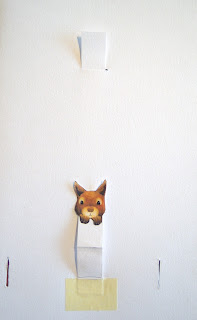
I decided to try and use a more complex method to create this pop up - the tree's bulge and shape is created by a lever on the opposite page that pulls it in, and the squirrel is able to pop out from behind the tree using a lever which pulls at the top of the page.


As I was happy with the way the dummy for Page 3 turned out, I went ahead and made a full colour version.
Again, I have managed to keep the pop-up version close to the original so nothing was lost in translation from turning a 2-Dimensional illustration to a 3-Dimensional pop-up.
I like how movement happens in two places - the rounding of the tree as you open the page, and the poping up of the squirrel as you pull the lever. The light weight paper I used has just the right amount of give to allow for the bending and shaping of the tree trunk.
The audience participation and interaction of this pop up is crucial as it moves the story along, giving a sense of enjoyment and importance to the viewer.
Page 12
 |
| My original illustration for Page 12 of the book 'Hedgehog Hibernates' |
Above, is the original illustration for Page 12 of of 'Hedgehog Hibernates' - below, is my pop-up experiment for Page 12...


Above is my dummy run through for my Page 12 pop-up.
This time I created a tab which could be pulled down to reveal a 3-Dimensional representation of the hedgehog in the log.


As I was happy with the way the dummy for Page 12 turned out, I went ahead and made a full colour version.
Again, I have managed to keep the pop-up version close to the original so nothing was lost in translation from turning a 2-Dimensional illustration to a 3-Dimensional pop-up.
The audience interaction from this pop up design is to reveal part of what's happening in the story - again, giving a sense of enjoyment and importance to the viewer.
The audience interaction from this pop up design is to reveal part of what's happening in the story - again, giving a sense of enjoyment and importance to the viewer.
Paper Engineering - Louise Rowe
Another paper engineer/illustrator that I have come across in my research is Louise Rowe.
Her pop-up books of folktales bring a new lease of life to traditional stories that really engages the viewer.


Her pop-up books of folktales bring a new lease of life to traditional stories that really engages the viewer.


Even though her pop-ups lack any pullies or levers for the audience to interact further with, I really like the way she has created these elaborate settings for children to look at and play with. I too hope to incorporate these 3-Dimensional elements into my pop-up experiments.
Paper Engineering - A New Suit For Santa
The book 'A New Suit For Santa' uses a paper santa insert and paper pockets to help tell the story of Santa finding a suit that looks right.
This book is great for audience participation and interaction as they can contribute to the story by moving and placing the character into a different suit, helping Santa along on his journey.
Obviously the storyline of this book is tailored to match the interaction that the book provides - my story would only fit this format if I were to change it into 'finding a place in which a hedgehog could hibernate in'.


This book is great for audience participation and interaction as they can contribute to the story by moving and placing the character into a different suit, helping Santa along on his journey.
Obviously the storyline of this book is tailored to match the interaction that the book provides - my story would only fit this format if I were to change it into 'finding a place in which a hedgehog could hibernate in'.


Paper Engineering - Kristina Gordon
Reading this article from ArtBox Magazine about Kristina Gordon's 3-Dimensional paper representations of her 'Yap Yap' characters, again shows that translating a 2-Dimensional idea into the 3rd Dimension can work well and look successful.


Aside from the influence of her successful paper engineering, I really like the way she has created a 3-Dimensional scene for the characters to be placed in - something that I too am thinking about experimenting in...
Having a scene like that with characters in it, creates scope for the charaters be able to move around it, and therefore creating the audience interaction I am after - the audience can tell the story themselves by moving the characters through a set scenery.
A Little History Of The Pop-Up Book...
Here is a short video about the history of the pop-up book...
It's interesting to find out about the early forms of the pop-up book - from the devices they used to create movement and interaction, to the colour printing processes that were involved, and how these methods pathed the way for the paper engineering we see today.
Paper Engineering - Stuart McLachlan
I really like the style and depth that is created in McLachlan's paper engineering work. The build up of layers using multiple sheets of cut out paper draws the viewer into the image, creating a further interest and appeal than that of a 2-Dimensional illustration.
Though his work is incredibly beautiful, I think to mimic this style into a pop up or a paper theatre experiment wouldn't be successful or suitable for a children's pop up book as the work is too intricate and delicate for the hands of a child.


All Things Paper!
I came across a blog - http://uponafold.com.au/blog - which posts about all things to do with paper crafting.
Alot of the work on there isn't directly linked to pop-up books, but I did come across one post about a paper engineer called Stuart McLachlan.
Alot of the work on there isn't directly linked to pop-up books, but I did come across one post about a paper engineer called Stuart McLachlan.
Pop Up Book Research
One of the most common forms of interpreting a book into an interactive story book is by making it into a pop up book.
Pop up books are perfect for allowing audience participation to move a story along - creating a fun way to join in with the character's journey.
Quite a few children's books end up getting changed into pop up books -
Pop up books are perfect for allowing audience participation to move a story along - creating a fun way to join in with the character's journey.
Quite a few children's books end up getting changed into pop up books -
 |
| Original Edition of 'The Incredible Book Eating Boy' by Oliver Jeffers |
 |
| Photograph of my own copy of the Pop Up Edition of 'The Incredible Book Eating Boy' by Oliver Jeffers |
 |
| Photograph of my own copy of the Pop Up Edition of 'The Incredible Book Eating Boy' by Oliver Jeffers |
 |
| Original Edition of 'Lost and Found' by Oliver Jeffers |
 |
| Photograph of my own copy of the Pop Up Edition of 'Lost and Found' by Oliver Jeffers |
 |
| Photograph of my own copy of the Pop Up Edition of 'Lost and Found' by Oliver Jeffers |
Below is a video of the Pop-Up Edition for the children's book 'Guess How Much I Love You' - written by Sam Mc Bratney and Illustrated by Anita Jeram.
 |
| Pop Up Edition of 'The Tale of Peter Rabbit' by Beatrix Potter |
Subscribe to:
Posts (Atom)